
British Columbia Sector Profile: Agriculture
Highlights
- Agriculture in B.C. is a diverse industry that includes fruit and vegetable cultivation among many other crops; animal husbandry; and western Canada's only major winery regions. Dairy was the largest segment of agriculture in the province from 2016 to 2020.
- The sector accounts for 0.8% of the province's total employment.
- British Columbia's agricultural sector continues to adapt to the effects of climate change. Increased frequency of extreme weather events including floods and wildfires have a major impact on workers and operations.
- The median hourly wage for agriculture sector employees in B.C. was $20.00/hr in 2021.
- The agriculture sector in the province faces a worker shortage and relies significantly on temporary foreign workers with around 1 in 5 agricultural jobs filled by the program. The COVID-19 pandemic has intensified the worker shortage by creating travel challenges for workers to fill positions as fruit pickers, for example.
Provincial Overview
Agriculture forms a unique part of British Columbia's economy. This sector varies considerably from other provinces in Canada due to B.C.'s warmer and more temperate climate. Mountainous terrain across the province limits the availability of open farmland, which is a strong characteristic of the majority of Western Canada. Within British Columbia, there is considerable variation regionally from the fertile soil of the Lower Mainland, to the drier climate of the Okanagan and the prairie type environment of the Peace Region.
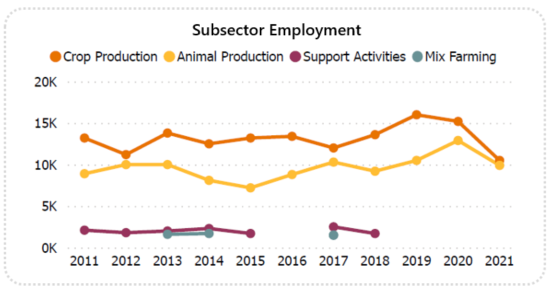
Source: Statistics Canada Labour Force Survey, ESDC custom table
Subsector Employment
Note: Figures shown are employment estimates. Missing values for Support Activities and Mix Farming indicate data that has been suppressed.
Show graphic in plain text
Year
Crop
ProductionAnimal
ProductionMix
FarmingSupport Activities
for Agriculture
2011
13,200
8,900
N/A
2,100
2012
11,200
10,000
N/A
1,800
2013
13,800
10,000
1,600
2,000
2014
12,500
8,100
1,700
2,300
2015
13,200
7,200
N/A
1,700
2016
13,400
8,800
N/A
N/A
2017
12,000
10,300
1,500
2,500
2018
13,600
9,200
N/A
1,700
2019
16,000
10,500
N/A
N/A
2020
15,200
12,900
N/A
N/A
2021
10,500
9,900
N/A
N/A
In 2021, the sector employed approximately 22,000 workers. Within the subsectors, 10,500 were employed in crop production, 9,900 were employed in animal production, with the remaining balance employed in support activities and mix farming. Around 33.9% of the sector is described as self-employed. Overall, there were approximately 15,841 farms across the province in 2021. [1] The median hourly wage for agriculture sector employees in B.C. was $20.00/hr in 2021. [2]
Agricultural activities in British Columbia are diverse, involving the growing of fruits and vegetables, mushrooms, crops, animal husbandry as well as support activities for the industry. As well, British Columbia features Western Canada's only major winery regions, which are only rivaled in domestic production capacity by Ontario. The province also features country's second largest greenhouse area at 66.0 million square feet, 20% of Canada's greenhouse area. [3]
Around 58.5% of the workforce in this sector is male while 41.5% is female. Despite the sector being majority staffed by males, British Columbia had the highest percentage of female farm operators in the country. [4] Age trends in the sector show that around 47.3% of the workforce is between 25-54 years of age, with 37.5% over the age of 55 and 14.7% between the ages of 15-24 years.

Source: Statistics Canada Labour Force Survey, ESDC custom table
Of those employed in 2021:
Show graphic in plain text
Sector Trends
Over the past two years, the sector has been adapting to the impacts of climate change as well as other climate related concerns. Flooding, wildfires and heatwaves as well as unseasonably cool temperatures have all had significant impacts on the sector across British Columbia. In late 2021, significant flooding caused massive damage to farmland, including significant loss of crops land and livestock, in the Lower Mainland's Fraser Valley. [5] Torrential rainfall associated with this weather event also severed road and rail connections causing businesses in the agricultural sector to lose access to markets and processing facilities leading to the dumping of product. [6]
Wildfires also have presented significant challenges to the industry, especially to farmers and agricultural producers in British Columbia's Okanagan region. Wildfire smoke as well as the direct threat of fire damage poses a serious risk to the sector in this area. Wildfire smoke poses a health and safety risk for general farm workers whose job primarily takes place outdoors. The presence of smoke may lead to increased costs for the farming sector in the form of personal protective equipment costs as well as lost productivity if workers are unable to work. In addition to the threat to workers, crops are threatened due to the damaging effects of wildfire smoke. British Columbia's wine sector is particularly at risk due to the unique effects that wildfire smoke has on grapes, essentially spoiling the crop, leading to large economic impacts on wine producers. [7]

Source: Statistics Canada Labour Force Survey, ESDC custom table (2021)
1% of provincial employment comes from this sectorShow graphic in plain text
Despite challenges due to the damaging effects of climate events, the Government of British Columbia has continued to support farmers with a variety of funding programs and relief. In the aftermath of the 2021 wildfire season, the province provided farmers with $20M in relief to aid in covering expenses related to damage suffered due to wildfires. [8] As well, following the Lower Mainland flooding in late 2021 the Governments of Canada and British Columbia offered a $228M relief package to farmers that had sustained losses due to the damage. [9]

Source: Statistics Canada Labour Force Survey, ESDC custom table
Sector Employment
Note: Figures shown are employment estimates. Totals may not add to 100% due to rounding.
Show graphic in plain text
Year
Employment (Total)
Full-time
Part-time
2011
24,900
20,200
4,600
2012
24,200
18,700
5,500
2013
27,400
21,900
5,500
2014
24,500
20,400
4,200
2015
23,400
19,000
4,400
2016
24,200
19,400
4,800
2017
26,200
22,000
4,300
2018
25,100
19,200
5,900
2019
28,700
22,500
6,200
2020
30,300
22,400
7,800
2021
22,400
17,400
5,000
Spring 2022 has brought with it unseasonably cold temperatures partially due to the ongoing La Nina weather phenomenon. [10] These cooler temperatures have caused British Columbian fruit growers to delay their crops significantly in the Lower Mainland, Vancouver Island and the Okanagan. [11] However, cooler temperatures have also brought with it a delay to this year's wildfire season. [12]
Employment Outlook
British Columbia's farms faced difficult conditions in 2021. Heat waves during the summer were followed by floods in the late autumn. Cold conditions in early 2022 have also delayed crops. [13] These weather challenges have added to existing difficulties, including trade disputes, price volatility, labour shortages, and supply chain constraints. [14]
Overall employment in agriculture is forecast to be stable in 2022 and 2023, with low job growth for the province. [15] Employment in British Columbia's agricultural sector has been decreasing slowly, declining by approximately 2,500 (10%) employees over the last ten years. As well, the overall number of farms in the province has decreased by around 3,900 over the last ten years. [16] British Columbia's decline in number of farms is significantly steeper than the national average. [17]
The agriculture sector in Canada, including British Columbia, faces a worker shortage. Fruit pickers have been in short supply across the province, for example, partially as a result of the COVID-19 pandemic. [18] Designed to address worker shortages across Canada, the Temporary Foreign Worker Program is important to meeting the labour needs of British Columbia farmers. In 2018, temporary foreign workers made up 21.4% of all jobs filled in the agricultural sector, with 707 farms reporting that they employed at least one worker brought in from the program. In 2018, there were 9,514 jobs filled by workers from the program. [19] The COVID-19 pandemic disrupted the ability for famers to use temporary foreign workers due to health measures and travel restrictions. In March 2022, British Columbia's Ministry of Agriculture ended the requirement for temporary foreign workers to quarantine before arriving at a farm. [20]
Dairy was the largest single segment of BC's agriculture industry from 2016-2020. [21] The segment is forecast to benefit from slightly higher pricing and volumes are projected to rise for 2022. However, the increasing cost of feed for dairy animals is expected to raise overall costs. [22]
Overall farm cash receipts are forecast by Farm Credit Canada to rise 16.8% in British Columbia in 2022, slightly ahead of the forecast of a 15.9% national increase. [23]
Occupation of Interest: Managers in Agriculture
Managers in agriculture are responsible for planning, organizing and operating farms. They are often involved in planning which crops and livestock to grow or raise; coordinating activities such as planting and harvesting crops, or raising and breeding animals; managing personnel and financials; and ensuring maintenance of equipment and facilities. [24]
Though employment for Managers in agriculture declined in 2021, it is forecast to rise in 2022. Many managers in agriculture are also owners of their operations, with 69% being self-employed compared to 14% self-employment in all occupations.
Extreme climate conditions have added to the challenges faced by managers in agriculture. Government support for recovery, such as the $228 M Canada-BC Flood Recovery for Food Security program, is intended to support the return to operation after the 2021 floods. [25] Farmers also have access to programs such as the BC Land Matching Program that links retiring farmers with new farmers who seek to build a business. In April, the program announced it had supported succession in agriculture by achieving over 200 matches between farmers and landholders. [26]

Source: Statistics Canada Labour Force Survey, ESDC custom table
Occupational Employment
Note: Figures shown are employment estimates
Show graphic in plain text
Year
Employment
2011
9,200
2012
8,600
2013
8,400
2014
7,900
2015
8,200
2016
9,900
2017
9,800
2018
8,800
2019
9,200
2020
10,600
2021
6,300
For more information, see the Managers in Agriculture Market Report on Job Bank.
Note
In preparing this document, the authors have taken care to provide clients with labour market information that is timely and accurate at the time of publication. Since labour market conditions are dynamic, some of the information presented here may have changed since this document was published. Users are encouraged to also refer to other sources for additional information on the local economy and labour market. Information contained in this document does not necessarily reflect official policies of Employment and Social Development Canada.
Prepared by: Labour Market Information (LMI) Directorate, Service Canada, Western Canada and Territories Region
For further information, please contact the LMI team.
Endnotes
-
Statistics Canada. Table: 32-10-0166-01 (formerly CANSIM 004-0014) Farms classified by farm type, Census of Agriculture historical data Accessed June 28, 2022 ↑
-
Statistics Canada. Table 14-10-0064-01 (formerly CANSIM 282-0072) Employee wages by industry, annual. Accessed June 27, 2022 ↑
-
Statistics Canada. (June 15, 2022) Mushroom, greenhouse and highbush blueberry farming play pivotal role in British Columbia ↑
-
Statistics Canada. (June 15, 2022) Mushroom, greenhouse and highbush blueberry farming play pivotal role in British Columbia ↑
-
CBC News. (November 26, 2021) Flood damage could cost farmers hundreds of millions of dollars, B.C. Agriculture Council says ↑
-
Castanet. (November 29, 2021) Highway closures force Okanagan dairy farmers to dump milk as it can't get to Coast for processing ↑
-
University of British Columbia. How wildfires are tainting grapes with smoke and threatening the wine industry ↑
-
Government of British Columbia. (September 3, 2021) $20M to help B.C. ranchers, farmers recover from drought, wildfires ↑
-
Government of Canada. (February 7, 2022) $228 Million Flood recovery program helping B.C. farms return to production ↑
-
World Meteorological Organization (June 10, 2022) Stubborn La Niña persists ↑
-
Castanet. (May 25, 2022) Colder spring delaying cherry pick for farmers in the South Okanagan ↑
-
Business in Vancouver. (June 27, 2022) Cool spring leads to 'delayed start' of B.C.'s wildfire season, BCWS says ↑
-
Global News. (May 17, 2022) ‘Very stressful': Cold weather delays crops for many B.C. farmers, but no relief in sight ↑
-
Statistics Canada. (May 11, 2022) Canada's 2021 Census of Agriculture: A story about the transformation of the agricultures industry and adaptiveness of Canadian farmers ↑
-
Employment and Social Development Canada, Employment Outlook 2022-2024 (internal analysis). ↑
-
Statistics Canada. Table: 32-10-0166-01 (formerly CANSIM 004-0014) Farms classified by farm type, Census of Agriculture historical data Accessed June 28, 2022 ↑
-
Statistics Canada. (June 15, 2022) Mushroom, greenhouse and highbush blueberry farming play pivotal role in British Columbia ↑
-
Okanagan Edge. (September 21, 2021) Apple pickers scarce in valley ↑
-
Statistics Canada. (April 17, 2020) COVID-19 Disruptions and Agriculture: Temporary Foreign Workers ↑
-
CBC News. (March 30, 2022) B.C. ends COVID-19 quarantine program for temporary foreign workers ↑
-
Agriculture and Agri-Food Canada (November 5, 2021) Overview of Canada's agriculture and agri-food sector ↑
-
Farm Credit Canada (February 1, 2022) 2022 Dairy sector outlook ↑
-
Farm Credit Canada (June 14, 2022) 2022 farm cash receipts forecast update: Inflation spreading across ag markets ↑
-
Government of Canada, Job Bank (July 5, 2022) Trend Analysis: Managers in agriculture ↑
-
Agriculture and Agri-Food Canada (February 7, 2022) $228 Million Flood recovery program helping B.C. farms return to production ↑
-
Government of British Columbia (April 13, 2022) B.C. Land Matching Program reaches new milestone ↑
Page details
- Date modified: