
British Columbia Sector Profile: Mining, Quarrying, and Oil and Gas
Highlights
- In B.C., the Mining, quarrying, and oil and gas sector is focused on coal, crude petroleum, and natural gas extraction.
- In the past ten years, employment in the sector is up 13.3% due to growth in oil and gas and mining. Most employment is in the mining and mixed mining subsector (58.5%).
- The sector accounted for nearly 5% of British Columbia's total GDP in 2021 and employed 28,300 people in the province in 2021. Most workers in the sector were in the Kootenay (25.6%),Lower Mainland-Southwest (22.7%) and Thompson-Okanagan (19.9%) regions.
- The COVID-19 pandemic had a substantial impact on employment as demand for oil and gas declined. In 2020, the sector lost 4,100 jobs in BC (-14.2%) though employment mostly recovered in 2021 with the addition of 3,600 jobs (+14.6%).
Provincial Overview
The mining and oil and gas sector has three subsectors: oil and gas extraction; mining and mixed mining; and support activities for mining and oil and gas extraction. Companies in the sector extract mineral solids, such as coal and ores; liquid minerals, such as crude petroleum; and gases, such as natural gas. This sector accounts for 1.1% of total annual employment for the province and contributed $10.5 billion or 4.8% to the province's annual GDP in 2021.
Source: Statistics Canada Labour Force Survey, ESDC custom table
Subsector Employment
Note: Figures shown are employment estimates
Show graphic in plain text
Year
Mining and
QuarryingSupport Activities for Mining
and Oil and Gas ExtractionOil and Gas
Extraction
2011
13,900
7,500
3,500
2012
13,700
8,400
3,300
2013
14,300
9,900
4,300
2014
14,100
9,900
6,500
2015
15,600
7,900
5,400
2016
18,100
9,600
4,000
2017
17,800
7,600
5,400
2018
17,600
8,100
4,500
2019
15,300
7,800
5,600
2020
14,300
4,500
5,900
2021
16,500
7,000
4,700
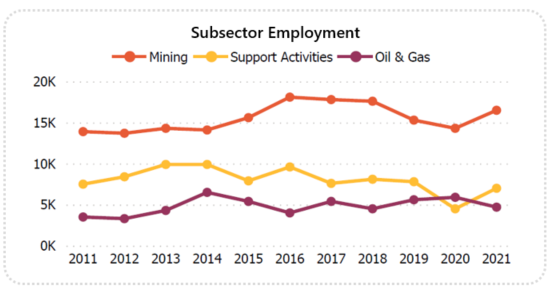
Most employment is in the mining and mixed mining subsector (58.5%). There are 26 major mines currently operating in B.C. , including fifteen metal mines, nine coal mines, one sand and gravel mine, and one industrial mineral mine.
Oil and gas extraction accounts for nearly a quarter (24.8%) of the sector's employment, focused in the Northeast region within the Western Canada Sedimentary Basin [1] The natural gas industry is larger than the province's oil industry. [2] In 2020, oil and gas extraction contributed $4.8 billion to the total provincial GDP and represented 45.7% of the annual GDP for the sector as a whole.

Source: Statistics Canada Labour Force Survey, ESDC custom table
Gender Distribution (2021)
Show graphic in plain text
Gender
% of Sector Employment
Female
16%
Male
84%
Mining and oil and gas employment is concentrated in the southeastern corner of the province. The Kootenay economic region accounts for the largest share of the sector's employment (25.6%), followed by the Lower Mainland – Southwest (22.7%) and the Thompson – Okanagan (19.9%) economic regions. The Vancouver Island and Coast and Cariboo economic regions accounted for the smallest share of the sector's employment, with 9.2% and 6.7% respectively.
Support activities for mining and oil and gas extraction account for the smallest share of the sector's employment at 24.8%. Occupations in this subsector support exploration and production activities by supplying products and services such as exploratory, geophysical, and drilling services, as well as supplies, manufacturing, and pipelines. In 2020, the support activities for the mining and oil and gas extraction subsector contributed $1.1 billion to the total provincial GDP and accounted for 20.3% of the sector's total annual GDP.

Note: Employment estimates are suppressed for the 15-24 age group
Source: Statistics Canada Labour Force Survey, ESDC custom table
Age Distribution (2021)
Note: Employment estimates are suppressed for the 15-24 age group
Show graphic in plain text
Age Group
% of Sector Employment
15-24 years
N/A
25-54 years
74%
55+ years
21%
Sector Trends
Over the past decade, the sector grew 13.3%, adding 3,300 jobs, with an average annual growth rate of 1.62%. Over that period, job growth in oil and gas extraction (34.3%) and mining and mixed mining (18.7%) offset employment losses in support activities for mining and oil and gas extraction (-6.7%). In 2021, Indigenous workers accounted for 9.19% of the sector's total workforce, higher than the average representation of Indigenous workers in B.C.'s workforce.
Public health restrictions due to COVID-19 led to decreased demand for petroleum and gas products and consequently employment dropped. In 2020, employment in the sector lost 4,100 jobs, the majority of which were concentrated in support activities for mining and oil and gas extraction (-3,300).

Source: Statistics Canada Labour Force Survey, ESDC custom table
Mining, Quarrying, & Oil and Gas Employment
Note: Figures shown are employment estimates
Show graphic in plain text
Year
Employment
2011
24,900
2012
25,400
2013
28,600
2014
30,500
2015
29,000
2016
31,700
2017
30,800
2018
30,200
2019
28,700
2020
24,600
2021
28,200
The sector started to recover from the pandemic, as employment increased by 14.6% or 3,600 jobs in 2021. There remained still slightly fewer people employed in the sector, though, than in the year prior to the pandemic. Still, employment within the sector will continue to be supported by the ramp-up of the sector's operations, continued recall of workers let go as a result of the pandemic, and multiple upcoming large-scale projects.
Construction is well underway, for example, on LNG Canada, a $40-billion LNG project to create a 670-kilometer pipeline carrying natural gas from Dawson Creek to a new processing plant on the coast in Kitimat. Once operational, as many as 950 permanent jobs are expected to be created. Construction on the project began in 2018 and is expected to take five years to complete. [3]
On the mining front, the Mount Polley Mining Corporation is looking to ramp up production at the company's gold and copper mine located northeast of William's Lake. The mine will initially look to fill 130 roles in pit operations but will require a total of 355 employees once mill operations are restarted. [4] The company targeted full production for the spring of 2022.
Similarly, Seabridge Gold plans to invest $150M this year into the company's KSM Project near Stewart. The proposed site has already received federal and provincial environmental assessment approvals for a new gold mine, where an estimated 1,400 onsite jobs would be available during the mine's operations. The company expects the mine to have a lifespan of 52 years [5] .

Source: Statistics Canada, Table 36-10-0400-01 (2021)
5% of the province's total GDP comes from this sectorShow graphic in plain text
Employment Outlook
Pressure from investors and from regulators to address environmental, social, and governance risks will continue to shape the sector. A period of lower oil prices has created greater discipline in capital investment in oil and gas, despite recent increases in the price of oil. [6]
In the longer term, reduced reliance on fossil fuels may affect employment patterns within the industry, particularly in liquifid natural gas and coal mining in B.C. Generally, employment in mining is volatile as it fluctuates with the operation of relatively few large sites and with changes in commodity prices. The volatility of employment in the sector presents a challenge in recruitment. Relatively low employment growth also limits the appeal of the sector to potential workers. These challenges combine to create a relatively tight labour market where the demand for workers is often greater than the number of workers available. [7]
While employment across this sector is projected to rise slightly this year (2021-2022), employment is forecast to remain roughly flat from 2021 through 2024. Employment is expected to drop in both mining and oil and gas extraction, while rising slightly in support activities. [8]
In the near term, employment may be supported by two large mines. Near Williams Lake, the Mount Polley copper-gold mine in is targeting reopening in 2022. The mine closed in 2019 due to low copper prices; the rising price of the commodity since 2020 has made operations economically feasible again. [9]
Another gold mine in development is the Premier Gold project on Nisga'a Nation Treaty Lands in northwestern BC. Initial targets for the project were to support 140 construction jobs and, upon entering operations in the first quarter of 2023, up to 280 jobs. [10]
Occupation of Interest: Underground Production and Development Miners
Underground production and development miners are directly involved in the extraction of coal, ore, and minerals from mines. Their duties may include the following:
- Set up and operate drills and drilling machines to produce blasting holes
- Operate specialized drills or boring machinery to create underground passageways
- Operate machinery to shear material from the working face in a mine
- Load and detonate explosives to fragment rock
- Operate machinery to load and haul material within the mine
- Maintain machinery and equipment [11]
Most workers in this occupation work in the mining subsector (64%) with a significant percentage in support activities for mining, oil and gas (17%); the remaining workers are in construction (5%). Over 95% of underground miners work full-time compared to 77% of workers in all occupations. Work is more likely to be seasonal; only 38% of underground miners work all year compared with 57% in all occupations.

Source: Statistics Canada Labour Force Survey, ESDC custom table
Occupational Employment
Note: Figures shown are employment estimates
Show graphic in plain text
Year
Employment
2011
3,100
2012
2,500
2013
3,700
2014
4,100
2015
2,800
2016
5,300
2017
3,900
2018
3,600
2019
6,400
2020
5,000
2021
3,800
Underground miners in British Columbia earned a slightly higher median wage ($37.30) than the overall Canadian median wage ($35.00). The highest median wages were in the Northeast Region ($39.56) and the Kootenays ($39.12), while the Thompson-Okanagan had the lowest median wage at $32.51.
More information on this occupation is available on Job Bank.
Note
In preparing this document, the authors have taken care to provide clients with labour market information that is timely and accurate at the time of publication. Since labour market conditions are dynamic, some of the information presented here may have changed since this document was published. Users are encouraged to also refer to other sources for additional information on the local economy and labour market. Information contained in this document does not necessarily reflect official policies of Employment and Social Development Canada.
Prepared by: Labour Market Information (LMI) Directorate, Service Canada, Western Canada and Territories Region
For further information, please contact the LMI team
Endnotes
-
Energy BC. Oil Infrastructure in British Columbia Map. Accessed April 24, 2022. ↑
-
Canada Energy Regulator. Provincial and Territorial Energy profiles – British Columbia. Accessed April 24, 2022. ↑
-
CBC. October 2, 2018. Just the FAQs on LNG Canada. ↑
-
Coast Mountain News. March 31, 2022. Mount Polley mine northeast of Williams Lake aims for recommissioning this spring. ↑
-
CKPG. March 21, 2022. Seabridge Gold mine in northwest B.C. to move ahead. ↑
-
Deloitte. 2022 Oil and gas industry outlook. ↑
-
Mining Industry Human Resources Council. March 2020. Canadian Mining Labour Market 10-Year Outlook 2020. ↑
-
Employment and Social Development Canada, Employment Outlook 2022-2024 (internal analysis). ↑
-
Mining.com. May 9, 2022. Imperial Metals speeds up work to reopen Mount Polley copper mine. ↑
-
Prince George Citizen. December 7, 2021. Gold mining project in northwestern B.C. gets green light from Mines Act. ↑
-
Government of Canada, Job Bank. Job Description: Miner in Canada. ↑
Page details
- Date modified: