
Manitoba Sector Profile: Mining, Quarrying, and Oil and Gas
Highlights
- In 2021, approximately 3,200 Manitobans were employed in the mining and quarrying and oil and gas extraction sector, down almost 18% from 2020.
- Indigenous people represent 23% of all those working in the mining sector in the province, almost three times the national average (8%).
- In 2019, the Government of Manitoba introduced the Manitoba Mineral Development Fund and the Manitoba-First Nations Mineral Development Action Plan to help grow mineral development and its labour force.
- In Manitoba, underground production and development miners represent about 19% of all those working in this sector and have a median wage of $35.00 per hour. The average annual income for this occupation is estimated to be $96,303.
Provincial Overview
There were approximately 3,200 Manitobans employed in the mining and quarrying and oil and gas extraction sector in 2021, representing 0.3% of total annual employment for the province. Most of this sector's employment is concentrated in the mining (except oil and gas) and mixed mining subsector (63%) and support activities for mining and oil and gas extraction subsector (28%).

Note: Oil and Gas employment estimates are suppressed for 2011, 2018, and 2021
Source: Statistics Canada Labour Force Survey, ESDC custom table
Subsector Employment
Note: Figures shown are employment estimates. Oil and Gas employment estimates are suppressed for 2011, 2018 and 2021.
Show graphic in plain text
Year
Mining and
QuarryingSupport Activities for Mining
and Oil and Gas ExtractionOil and Gas
Extraction
2011
3,900
1,500
N/A
2012
3,600
1,900
500
2013
3,900
1,700
500
2014
4,000
1,700
500
2015
3,600
1,000
600
2016
4,000
1,000
500
2017
4,500
1,300
700
2018
4,100
1,400
N/A
2019
2,600
1,300
800
2020
2,600
700
500
2021
2,000
900
N/A
While less than 1% of those employed in Manitoba's mining sector worked in oil and gas extraction, the subsector contributed over 60% of the sector's total GDP in 2021 ($1.5 billion). Oil and gas revenue is down 4% on an annual basis. [1] All of Manitoba's current oil production is located in southwest Manitoba. [2]
Mining and quarrying generated $479.3 million in GDP in 2021, down 6% year-over-year. There are currently four active mines in Manitoba and these operations are the province's primary employers for its mining sector:
- Hudbay - 777 Mine in Flin Flon (copper, zinc)
- Hudbay - Lalor Mine in Snow Lake (copper, zinc, gold)
- Vale - Thompson Mine in Thompson (nickel, copper)
- Sinomine Rare Metals Resources Co. Ltd. - Tanco Mine in Bernic Lake (cesium) [3]
While Manitoba has a relatively small mining industry, its economic impact is significant for many northern communities. Three of Manitoba's four active mines are situated in the province's northern region. In 2021, over 40% of Manitoba's mining sector employment was located in the Parklands and North economic region. According to Census 2016, mining and quarrying combined with mining support activities contributed over 32% of all employment income in Thompson, and over 38% in Flin Flon. [4] Employment is also distributed in the Winnipeg (19%), Southwest (16%), and Southeast (14%) economic regions.
Mine operations fuel local economies by offering high-paying direct employment. They also create indirect employment and bolster local revenue through the purchase of goods and services .

Source: Statistics Canada Labour Force Survey, ESDC custom table
In 2021, 91% of workers were maleShow graphic in plain text
The mining sector had one of the largest shares of Indigenous workers of any industry in Manitoba in 2021, representing 23% of all those employed in mining and quarrying and oil and gas extraction. [5] For this reason, any significant changes in mining employment are expected to impact labour market outcomes for Manitoba's Indigenous population.
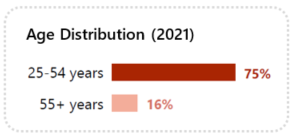
Note: Employment estimates are suppressed for the 15-24 age group
Source: Statistics Canada Labour Force Survey, ESDC custom table
Age Distribution (2021)
Note: Employment estimates are suppressed for the 15-24 age group
Show graphic in plain text
Age Group
% of Sector Employment
15-24 years
N/A
25-54 years
75%
55+ years
16%
Sector Trends
Employment in Manitoba's mining and quarrying and oil and gas extraction sector decreased 18% (-700) in 2021 and has been trending down since 2017, with an average annual growth rate of -16% over the last four years. Operational changes for mines located in Thompson and Flin Flon are at the root of these employment losses.

Source: Statistics Canada Labour Force Survey, ESDC custom table
Mining, Quarrying, & Oil and Gas Employment
Note: Figures shown are employment estimates
Show graphic in plain text
Year
Employment
2011
5,700
2012
6,000
2013
6,000
2014
6,200
2015
5,200
2016
5,500
2017
6,500
2018
5,800
2019
4,700
2020
3,900
2021
3,200
Vale eliminated approximately 400 positions at their Thompson operations between 2017 and 2018. [6] In 2020, Vale performed a second comprehensive review of its Manitoba operations, resulting in another significant workforce reduction in Thompson and impacting almost 150 workers. [7]
Hudbay's 777 mine in Flin Flon is set to close by fall 2022, which will result in approximately 275 workers leaving the company. The majority of the remaining 800 employees staying with Hudbay will be relocated to Snow Lake to support expansion of the company's Lalor Mine. [8] , [9]
In an effort to help grow and develop economic diversification in northern Manitoba, the Government of Manitoba established the Manitoba Mineral Development Fund in 2019. The Province contributed $20 million to the fund and has committed to provide ongoing funding on an annual basis. The Manitoba Mineral Development fund is available to support eligible communities and businesses, including Indigenous groups, municipalities and the not-for-profit sector. This program funds activities that help advance new mining opportunities and outreach to First Nations for collaborative resource development. [10]
In 2019, the Government of Manitoba released the Manitoba-First Nations Mineral Development Action Plan that includes a series of agreements to ensure First Nations are included in all phases of mine development within their traditional territories. One of the priorities built into these agreements is the implementation of enhanced First Nations community participation through mining sector training and employment opportunities. [11]
Employment Outlook
The mining and quarrying and oil and gas extraction sector is sensitive to shifts in the global environment and, as such, employment prospects in the sector can significantly vary from year to year. The price and demand for resources, as well as global trends, are key factors that influence expansion and exploration decisions and the trajectory of employment opportunities. While employment prospects within the sector are currently limited and employment growth has been trending downwards, mining development projects and recently announced federal strategies have potential to improve employment outlook in the long-term.
Recent job losses at the Flin Flon and Thompson mines may eventually be offset by the Hudbay expansion in Snow Lake and new prospects such as planned mining projects in Lynn Lake (Alamos Gold) and Norway House. Alamos Gold is currently in the permitting process for its Lynn Lake Project. The company also expects to have a construction plan for this project by the end of 2022. [12] Norway House Cree Nation and the Flying Nickel Mining Corporation recently signed an agreement for the development of a nickel mine (Minago Nickel Project) in northern Manitoba. While a clear timeline has not been set, the Minago Nickel Project is expected to employ up to 450 people once fully operational. [13] Other advanced mining projects underway in Manitoba include the Talbot project near Moose Lake, the Tower project south of Snow Lake (Rockcliff Metals) and the Monument Bay project near Red Sucker Lake (Yamaha Gold Inc.). [14]
Mining exploration activities throughout the province are also on the rise. Estimated exploration expenditures in Manitoba for 2021 were forecast at $74 million, up 31% from 2020 and up 61% from 2019. [15] Renewed interest in mining and exploration in northern Manitoba is driven by profitability and closely linked to the fluctuating price of base and precious metal commodities. For example, the price of nickel spiked in the first few weeks of the Russia-Ukraine conflict in February 2022 and then followed by a downward price correction. The price is expected to increase in the long term due to the use of nickel in lithium-ion batteries used in electric vehicles. [16] , [17] Meanwhile, the price of gold has trended up over the last five years and is traditionally seen as a safe investment during times of economic uncertainty. [18] , [19]
The global transition away from fossil fuels and towards cleaner energy is contributing to a significant growth in demand for electric vehicles and the lithium-ion batteries used to power them. To capitalize on the rising demand of lithium, Snow Lake Resources, New Age Metals and Grid Metals Corp. will be investing more than $15 million between them in 2022 on lithium exploration. Snow Lake Resources is also exploring next steps and potential partnerships for building North America's first lithium processing facility in Winnipeg. [20] The company's vision for lithium not only supports job creation, it also seeks to position Manitoba as an important supplier for the global market.
In the medium-term, employment opportunities in the province's mining sector will be further bolstered by the Government of Canada's plans to implement the Critical Minerals Strategy. This Strategy was introduced in Budget 2022 with the aim to support job and economic growth. [21]
Occupation of Interest: Underground Production and Development Miners
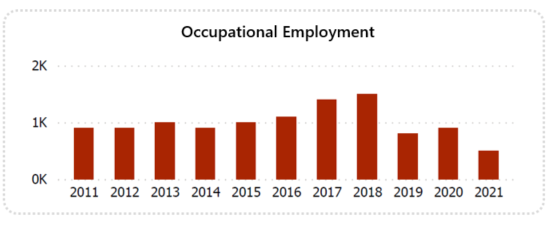
There were approximately 600 Manitobans employed as underground production and development miners in Manitoba in 2021. The occupation represents approximately 19% of all those employed in Manitoba's mining and quarrying and oil and gas extraction subsector. There has been a marked decline in those working in this occupation over the last four years in Manitoba due to mine closures and restructuring. As such, local job prospects are considered limited at this time. However, increased exploration activities combined with the existence of new and advanced mining projects in the province could bolster employment opportunities for this occupation in the long term. The Conference Board of Canada forecasts fair employment growth prospects for this occupation over the next 5 and ten years. [22]
Source: Statistics Canada Labour Force Survey, ESDC custom table
Occupational Employment
Note: Figures shown are employment estimates
Show graphic in plain text
Year
Employment
2011
900
2012
900
2013
1,000
2014
900
2015
1,000
2016
1,100
2017
1,400
2018
1,500
2019
800
2020
900
2021
500
According to the Conference Board of Canada, underground miners were the largest occupation group in northern Manitoba in 2017. [23] However, employment for these workers can fluctuate, depending on commodity prices and individual mine cycles.
The nature of this work can be rotational and may require living away from home in work camps. However, this occupation does offer a higher than average wage. The median wage offered for underground production and development miners in Manitoba is $35.00 per hour, on par with the national average. The average annual income for this occupation is estimated to be $96,303. [24]
Underground production and development miners work for underground mines or specialized contractors in mine, shaft, and tunnel construction. These workers drill, blast, and operate mining machinery. This occupation requires a high-school diploma, classroom and on-the-job training and often requires experience as a mine labourer. [25] To support the development of a skilled labour force in this occupation, the Northern Manitoba Mining Academy (NMMA) provides coordinated training opportunities linking mining employers with educators and local First Nations to deliver job readiness training for Indigenous miners. [26] While this training is not mandatory, the three-month program offered by NMMA does help prepare Indigenous people to work as miners.
Note
In preparing this document, the authors have taken care to provide clients with labour market information that is timely and accurate at the time of publication. Since labour market conditions are dynamic, some of the information presented here may have changed since this document was published. Users are encouraged to also refer to other sources for additional information on the local economy and labour market. Information contained in this document does not necessarily reflect official policies of Employment and Social Development Canada.
Prepared by: Labour Market Information (LMI) Directorate, Service Canada, Western Canada and Territories Region
For further information, please contact the LMI team
Endnotes
-
Statistics Canada. Table: 36-10-0402-01 (formerly CANSIM 379-0030) Gross domestic product (GDP) at basic prices, by industry, provinces and territories (x 1,000,000). ↑
-
Government of Manitoba. Agriculture and Resource Development. Accessed on March 9, 2022. ↑
-
Government of Manitoba. Manitoba's Mineral Industry; Manitoba Mineral Sector Profile. Accessed March 7, 2022. ↑
-
Statistics Canada. Census 2016, ESDC Custom table. ↑
-
Statistics Canada. Labour Force Survey ESDC Custom Table. ↑
-
Thompson Citizen (December 19, 2018). Vale ends 2018 with roughly 400 fewer Thompson employees than a year ago. ↑
-
Thompson Citizen (October 29, 2020). Elimination of nearly 150 jobs at Vale a ‘punch in the stomach for Thompson'. ↑
-
Flin Flon Reminder (September 29, 2020). Hudbay 2022 mine closure, care and maintenance details issued to employees. ↑
-
The Reminder (February 11, 2022). Zinc plant to shut down in May, 777 and mill in June, about 275 layoffs expected, shop and admin to stay open: Hudbay. ↑
-
Government of Manitoba (October 16, 2019). Manitoba announces new mineral development fund. ↑
-
Government of Manitoba. Manitoba – First Nations Mineral Development Protocol. Accessed March 9, 2022. ↑
-
Alamos Gold (December 16, 2021). Alamos Gold provides exploration update for the Lynn Lake Project, Manitoba, including new Greenfields discovery. ↑
-
CBC News (February 17, 2022). Northern Manitoba nickel expected to provide jobs, multimillion-dollar economic boost. ↑
-
Natural Resources Canada (March 2021). Mining = Opportunities for Indigenous Communities in Manitoba. ↑
-
Government of Manitoba. Manitoba Mining, Exploration and Geoscience 2022-2023. Accessed March 8, 2022. ↑
-
Natural Resources Canada. Gold Facts. Accessed March 22, 2022. ↑
-
Energy & Metals Consensus Forecasts (March 21, 2022). Subscription only. ↑
-
Winnipeg Free Press (April 12, 2022). Golden opportunity. ↑
-
Government of Canada. Canada's Critical Minerals Strategy. Accessed on April 28, 2022. ↑
-
Conference Board of Canada (November 4, 2021). Skills development in northern mining regions, lessons from Manitoba. ↑
-
Conference Board of Canada (November 4, 2021). Skills development in northern mining regions, lessons from Manitoba. ↑
-
Conference Board of Canada (November 4, 2021). Skills development in northern mining regions, lessons from Manitoba. ↑
-
Conference Board of Canada (November 4, 2021). Skills development in northern mining regions, lessons from Manitoba. ↑
-
Conference Board of Canada (November 4, 2021). Skills development in northern mining regions, lessons from Manitoba. ↑
Page details
- Date modified: