
Manitoba Sector Profile: Professional, Scientific and Technical Services
NAICS 54
- Workforce characteristics
- Main occupations
- Occupation of interest: Financial auditors and accountants (NOC 11100)
Highlights
- In 2022, there were 35,500 people employed in the professional, scientific and technical services (PSTS) sector, up 12.3% from 2021. Approximately 23% of workers in the sector were self-employed, compared to just 11.0% across all industries.
- Since 2019, provincial employment in the PSTS sector has grown by 25.4%. The growth is fueled by a number of tech companies setting up headquarters in Winnipeg, establishing the city as one of Canada's tech hubs.
- The combination of a thriving tech sector, demand for skilled workers, and funding commitments by the government support a positive employment outlook for the PSTS sector in Manitoba between 2023 and 2024.
About the Sector
Composition and importance of the sector
The professional, scientific, and technical services (PSTS) sector is comprised of nine industry groups. A unique feature of this sector is that it does not rely on equipment and materials, but on worker skills. The main product sold within most industry groups is expertise. The nine industry groups are defined by the particular type of training required to provide each service. These groups are: legal services; tax preparation, bookkeeping and payroll services; architectural, engineering and related services; specialized design services; computer systems design and related services; management, scientific and technical consulting services; scientific research and development services; and advertising, public relations, and related services.

In 2022, the sector contributed to:
Source: Statistics Canada Labour Force Survey; Statistics Canada Table: 36-10-0402-01 (GDP at basic prices, chained 2012 dollars); Statistics Canada Table: 36-10-0400-01 (GDP at basic prices, current dollars)
Show graphic in plain text
Most employment in this sector is concentrated in architectural, engineering and related services (20.0%), computer systems design and related services (20.0%), and accounting, tax preparation, bookkeeping and payroll services (18.3%). [1] The remaining 41.7% of sectoral employment is divided into smaller percentages amongst the six remaining industry groups. [2]
Geographical distribution of employment
In 2022, three-quarters of employment in the PSTS sector was concentrated in the Winnipeg economic region. By comparison, the Winnipeg region was home to 62% of all provincial employment. The region's thriving corporate and academic presence has attracted talented individuals to work in this central hub.
While the Southeast economic region accounted for a smaller share of employment at 9.3% in 2022, its proximity to the Winnipeg economic region has been advantageous. Many of the region's larger cities and towns are within driving distance from Winnipeg, enabling workers to easily commute to job opportunities in the city.
Workforce
Workforce characteristics
There were 35,500 people employed in the sector in 2022, up 12.3% from 2021. While 55.8% of workers in the sector were male and 44.2% female, women outnumbered men slightly among workers 24 and under, and men made up an even greater share among workers 55 and older. Overall, the sector is an important and growing part of Manitoba's economy. Its workforce is diverse, with young female workers making up a significant proportion.
Interestingly, those working in PSTS in Manitoba were more likely to be self-employed compared to other industries in the province. In fact, in 2022, 23.1% of workers in this sector were self-employed, compared to just 11.0% across all industries. However, Manitoba falls slightly behind the Canadian average of 25.9% of self-employed workers in this sector.
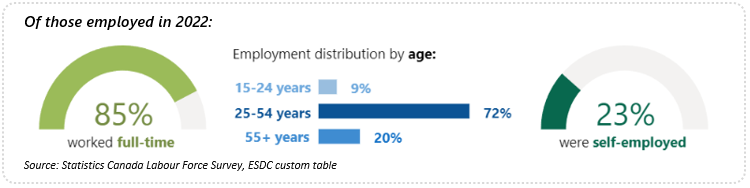
Of those employed in 2022:
Source: Statistics Canada Labour Force Survey, ESDC custom table
Show graphic in plain text
Main occupations
Financial auditors and accountants are the largest occupation group in the professional, scientific, and technical services sector, making up 6.0% of sector employment in 2022. [3] Accounting technicians and bookkeepers make up the second largest occupation group with 5.6% of employment, followed by information systems specialists (5.3%), software developers and programmers (5.0%), and professional occupations in business management consulting (5.0%). [4]
Occupation of interest: Financial auditors and accountants (NOC 11100)
Financial auditors examine and analyze the accounting and financial records of individuals and establishments to ensure compliance with accounting standards. Accountants plan, organize and administer accounting systems for individuals and establishments. Auditors and accountants are employed by private sector accounting and auditing firms or public sector accounting and auditing departments. They may also be self-employed.
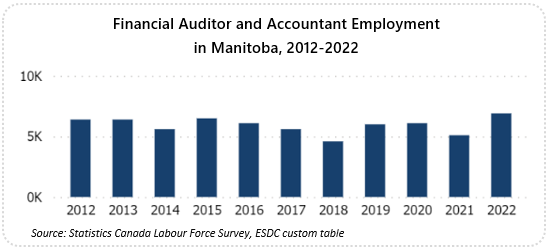
Financial Auditor and Accountant Employment in Manitoba
Note: Figures shown are employment estimates
Source: Statistics Canada Labour Force Survey, ESDC custom table
Show graphic in plain text
Year
Employment
2012
6,400
2013
6,400
2014
5,600
2015
6,500
2016
6,100
2017
5,600
2018
4,600
2019
6,000
2020
6,100
2021
5,100
2022
6,900
Financial auditors and accountants in Manitoba earn an hourly median wage of $35.00/hour, $3.46/hour lower than the national median hourly wage for this occupation ($38.46/hour). To be employed in this occupation, a university degree and completion of a professional training program is required.
The employment outlook for the period 2022-2024 is very good for financial auditors and accountants in Manitoba. Additional occupational information can be found here.
Recent History
Between 2000 and 2018, the PSTS sector in Manitoba maintained consistent employment within a range of approximately 23,000 to 28,000 workers. In 2019, Winnipeg was identified as an emerging tech hotspot in North America, leading to a period of high growth in its tech workforce. [5] Since then, the PSTS sector in the province has grown by an impressive 25.4%. Large tech companies, such as SkipTheDishes and Bold Commerce, recognized the opportunity and established their headquarters in the city, leading numerous other companies to follow suit, cementing Winnipeg's position as a tech hub in Canada. [6] By 2022, the PSTS sector contributed $2.2 billion to Manitoba's annual GDP. [7]
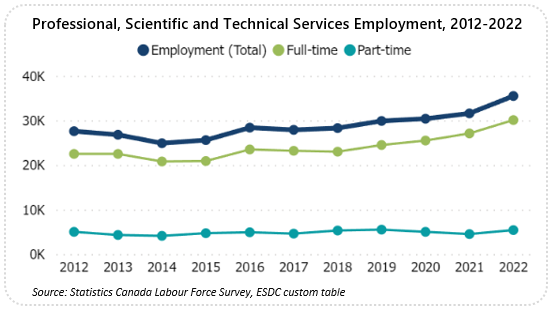
Professional, Scientific and Technical Services Employment
Note: Figures shown are employment estimates. Totals may not add to 100% due to rounding.
Source: Statistics Canada Labour Force Survey, ESDC custom table
Show graphic in plain text
Year
Employment (Total)
Full-time
Part-time
2012
27,600
22,500
5,000
2013
26,800
22,500
4,300
2014
24,900
20,800
4,100
2015
25,600
20,900
4,700
2016
28,400
23,500
4,900
2017
27,900
23,200
4,600
2018
28,300
23,000
5,300
2019
29,900
24,500
5,500
2020
30,400
25,500
5,000
2021
31,600
27,100
4,500
2022
35,500
30,100
5,400
The PSTS sector provides services to many different industries in Manitoba, including manufacturing, transportation and warehousing, and agriculture, all of which rely on professional and scientific services to maintain a competitive edge. One key example is the bioscience economy in the province, which consists of over 700 companies. The biotech industry grew by 7,500 jobs in 2021 despite a drop in revenue, from $10.4 billion to $9.9 billion, mainly due to drought conditions affecting the agriculture industry's ag-biotech sector. [8]
In addition to private sector growth, the PSTS sector is benefitting from government funding. In 2022, PrairiesCan provided $22.7 million to support state-of-the-art projects in virtual media production, drone testing facilities, and other innovative scientific and technical businesses. This funding is expected to create approximately 850 new jobs. [9] Government-supported initiatives aimed at promoting the trend towards a greener economy are also helping to grow the sector. [10] Recent funding includes $1.5 million from the Government of Manitoba to the Conservation and Climate Fund, $4.4 million from the federal government to study the conditions that affect the Hudson Bay Railway corridor, and funding from the Aerospace Regional Recovery Initiative to help the industry adopt environmentally sustainable practices. [11] , [12] , [13]
While 2022 was a positive year for the PSTS sector, the end of the year brought troubling news for technology firms. Major multinational corporations, including Amazon, Meta Platforms, Microsoft, and Google, cut tens of thousands of jobs company-wide. [14] SkipTheDishes, headquartered in Winnipeg, was also affected by this trend, laying off 350 staff at its headquarters in September. [15]

Top Subsectors by Employment
Note: Figures shown are employment estimates
Source: Statistics Canada Labour Force Survey, ESDC custom table
Show graphic in plain text
Year
Accounting
Architectural
& engineeringComputer
systems design
2012
4,700
5,700
4,700
2013
4,000
5,000
4,800
2014
3,600
4,300
5,700
2015
5,400
4,600
3,700
2016
6,100
5,700
4,600
2017
5,200
5,100
5,300
2018
5,200
5,800
4,800
2019
5,100
6,200
4,800
2020
5,800
5,200
5,800
2021
4,800
6,600
7,200
2022
6,500
7,100
7,100
Employment Outlook
Overall, the employment outlook for the PSTS sector in Manitoba is expected to be mainly positive between 2023 and 2024. Due to the diversity amongst the sector's industry groups and varying levels of employment that can be supported within each industry group, labour market demand and opportunities for growth across the sector are not evenly distributed. The overall positive outlook is based on multiple factors, including a thriving tech sector, consistent demand for workers with specialized skills, and recent government spending commitments.
Thriving Tech Sector
The Business Development Bank of Canada's 2022 Tech Industry Outlook predicts a 22.4% industry growth from 2021-2024 in Canada. [16] Supporting this prediction is a growing number of investments that larger firms are making in Manitoba, raising the profile of the sector and supporting employment opportunities. Several tech companies have announced plans to grow their business in Winnipeg, including Ubisoft and LotLinx, with plans to hire 200 and 30-50 staff, respectively. [17] Additionally, smaller companies like Steinbach-based RocketRez, a leading ticketing and business operations software platform, plans to increase staff by about 50% in 2023. [18] In a tight labour market, the level of growth points to potential recruitment challenges, some of which will be addressed through an increase of skilled workers immigrating to Manitoba.
Demand for Specialized Skills
The technical nature of many occupations within the sector create a consistent demand for skilled workers, many of whom have skills that afford them the option of mobility. This dependency on workers' expertise and skills is a significant contributor to a positive overall employment outlook. For example, the Province of Manitoba's Labour Market Outlook for 2022 to 2026 predicts 4,000 job openings in the sector from 2022 to 2026, which includes an annual labour shortage of 129 financial auditors and accountants. [19] Furthermore, a study by the Manitoba Veterinary Medical Association (MVMA) shows that the vacancy rate for veterinarians in Manitoba is 15%. The MVMA also reports that at least 100 veterinarians are needed to meet current demand. [20], [21]
Government Funding Commitments
A variety of government spending commitments are expected to bolster employment opportunities in the PSTS sector. An increase in opportunities related to scientific research will be supported by many funded projects, a key one being the federal and provincial governments, Shared Health, and University of Manitoba jointly committing $30 million to support patient-oriented health research in the province. [22] Additionally, the Province of Manitoba's new $50 million Venture Capital Fund, which supports creation of entrepreneurship-led businesses and province-wide economic growth [23] , provides access to a pipeline of new and expanding companies requiring the expertise of workers in the PSTS sector.
Endnotes
-
Statistics Canada. ESDC Custom Table. ↑
-
Statistics Canada. ESDC Custom Table. ↑
-
Statistics Canada. ESDC Custom Table. ↑
-
Statistics Canada. ESDC Custom Table. ↑
-
CTV News (November 18, 2022). Winnipeg tech sector experiencing growth thanks to expanding talent pool. ↑
-
Economic Development Winnipeg. Winnipeg named one of North America's next tech hot spots. (Accessed April 03, 2023). ↑
-
Statistics Canada. Table 36-10-0402-01 (formerly CANSIM 379-0030) Gross domestic product (GDP) at basic prices, by industry, provinces and territories (x1,000,000). (Accessed May 2, 2023). ↑
-
Winnipeg Free Press (October 28, 2022). Province's biotech sector shows impressive growth. ↑
-
Prairies Economic Development Canada (November 18, 2022). Minister Vandal announces federal investment supporting innovation and business growth in Manitoba. ↑
-
Prairies Economic Development Canada (November 18, 2022). Minister Vandal announces federal investment supporting innovation and business growth in Manitoba. ↑
-
Ibid. ↑
-
Government of Manitoba (May 10, 2022). Manitoba Government Launches $1.5 Million Conservation and Climate Fund. ↑
-
Thompson Citizen (July 14, 2022). Feds funding study on permafrost along Hudson Bay Railway. ↑
-
CTV News (January 20, 2023). Tech sector layoffs: Counting the companies and the cuts. ↑
-
CBC News (September 12, 2022). Skip the Dishes lays off about 350 Winnipeg staff. ↑
-
Business Development Bank of Canada (January 2022). Tech Industry Outlook. ↑
-
Winnipeg Sun (March 18, 2022). Game developer announces major Winnipeg investment. ↑
-
Winnipeg Free Press (January 31, 2023). Software company powers forward. ↑
-
Province of Manitoba. Manitoba Labour Market Outlook 2022 to 2026. Accessed April 12, 2023. ↑
-
CBC News (April 8, 2022). Veterinarian shortage weighs heavily on Manitoba livestock farmers. ↑
-
Winnipeg Free Press (July 6, 2022). Raining cats and dogs at Winnipeg Humane Society. ↑
-
Government of Canada (June 27, 2022). New investment in patient-oriented research in Manitoba. ↑
-
Province of Manitoba (April 29, 2022). Manitoba Government Invests $50 Million to Establish New Venture Capital Fund, Support Economic Growth. ↑
Page details
- Date modified: