
Saskatchewan Sector Profile: Public Administration
NAICS 91
- Workforce characteristics
- Main occupations
- Occupation of interest: Police officers (except commissioned) (NOC 42100)
Highlights
- In 2022, 36,700 people were employed in Saskatchewan's public administration sector, representing 6.3% of total employment in the province.
- Employment in public administration increased by 5,100 (16.1%) during the pandemic, between 2019 and 2021, driven by 3,500 job gains in provincial administration between 2019 and 2020, and 2,200 federal administration jobs between 2020 and 2021. Employment in the sector remained stable in 2022.
- Employment prospects in public administration should be fair for the period 2022-2024, with provincial administration having a more favourable job outlook, while federal and municipal administration may have limited employment opportunities.
About the Sector
Composition and importance of the sector
The public administration sector ranks fifth among all sectors by employment in Saskatchewan, accounting for 6.3% (36,700) of total provincial employment in 2022. The sector comprises establishments primarily engaged in activities of a governmental nature, that is, the enactment and judicial interpretation of laws and their pursuant regulations, and the administration of programs based on them.

In 2022, the sector contributed to:
Source: Statistics Canada Labour Force Survey; Statistics Canada Table: 36-10-0402-01 (GDP at basic prices, chained 2012 dollars); Statistics Canada Table: 36-10-0400-01 (GDP at basic prices, current dollars)
Show graphic in plain text
Jobs in public administration are concentrated in the federal and provincial administration subsectors. In 2022, the federal (34.6% or 12,700) and provincial government (34.1% or 12,500) accounted for over two-thirds (68.7%) of employment in public administration. Local, municipal, and regional public administration and Aboriginal, international, and other extra-territorial public administration made up the remaining 31.1% (11,400). [1]
Geographical distribution of employment
In 2022, over seven in ten (73.3%) public administration jobs were around Regina and Saskatoon, with over two fifths (42.0%) of the sector's employment in the Regina – Moose Mountain economic region, and 31.3% in Saskatoon – Biggar. Prince Albert and Northern (17.2%), Swift Current - Moose Jaw (6.5%), and Yorkton – Melville (3.3%) accounted for the remaining three in ten (27.0%) of public administration jobs in the province.
Workforce
Workforce characteristics

95% of those employed worked full-time in 2022.
Source: Statistics Canada Labour Force Survey, ESDC custom table
Show graphic in plain text
In 2022, 36,700 people were employed in Saskatchewan's public administration sector. Nearly all worked full-time (95.1%) with a slightly higher proportion of males working full-time (96.7%) compared to females (94.0%). Core-aged workers, 25 to 54 years, made up 73.0% of those working in the sector compared to one in five (20.2%) nearing retirement i.e., ages 55 and older. Provincial public administration (20.8%) had the highest share of older workers, 55 years or older, while municipal administration had the youngest workforce, with 10.5% of those employed aged 15 to 24 years. [2]
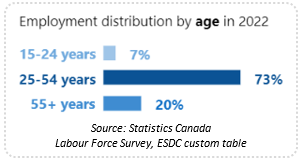
Employment distribution by age in 2022:
Source: Statistics Canada Labour Force Survey, ESDC custom table
Show graphic in plain text
Overall, in 2022 the sector's workforce was relatively even among males (49.7%) and females (50.3%). Females were most represented in provincial public administration (56.8%), and in federal government public administration (52.9%). Male workers were most represented in municipal administration (61.0%). Males also made up the majority (58.3%) of workers aged 15 to 24, while females made up the majority (51.4%) of workers aged 55 and older.
In Saskatchewan, three quarters (74.9%) of those occupying government jobs in 2022 have a post-secondary certificate or diploma, and 36.0% have a university degree. [3] Public administration workers in Saskatchewan earned a median hourly wage of $36.21/hour in 2022; below the national median wage for this sector ($38.97/hour) and second lowest among the western provinces. [4]
Main occupations
In Saskatchewan, there are many different occupations that fall under public administration. In 2022, the top five employed occupations were police officers except commissioned (9.5%), correctional service officers (6.0%), employment insurance and revenue officers (4.4%), administrative assistants (3.5%) and firefighters (3.0%). [5]
Occupation of interest: Police officers (except commissioned) (NOC 42100)
Police officers maintain order and enforce laws and regulations. They respond to emergency calls, patrol public areas, regulate traffic, control crowds, arrest offenders and build community relationships. They are employed by municipal and federal governments and some provincial and regional governments.

Police Officers (except commissioned) Employment in Saskatchewan
Note: Figures shown are employment estimates
Source: Statistics Canada Labour Force Survey, ESDC custom table
Show graphic in plain text
Year
Employment
2012
2,500
2013
2,800
2014
2,400
2015
2,600
2016
2,600
2017
3,300
2018
2,300
2019
3,200
2020
3,300
2021
2,500
2022
3,500
Police officers in Saskatchewan earn an hourly median wage of $45.33/hour, $0.82/hour less than the national median hourly wage ($46.15/hour). In Saskatchewan, the median wage for this occupation is lowest in the Regina‑Moose Mountain region at $42.50/hour, while it is equal across all other regions. A secondary school certificate is required to work in this occupation, as well as a three-to-six-month police training program. Most positions also require completion of a college program in police technology. Certain areas of policing may require specialized training or certification. Physical agility, strength, fitness and vision requirements must be met, and psychological and other tests are also required.
The employment outlook for the period 2022-2024 is good for police officers in Saskatchewan. Additional occupational information can be found here.
Recent History
Employment in the public administration sector is strongly influenced by economic conditions as well as the implementation or withdrawal of government policies and programs. Over the past few years, various programs and strategies were implemented by the different levels government to address the economic crisis left by the COVID-19 pandemic. As such, a record number of public servants are now employed in Saskatchewan. Employment in the province's public administration sector grew 16.1% (+5,100 jobs) from 2019 to 2022. By contrast, employment grew 5.0% (+1,500 jobs) from 2012 to 2019, the seven-year period prior to the pandemic.

Public Administration Employment
Note: Figures shown are employment estimates. Totals may not add to 100% due to rounding.
Source: Statistics Canada Labour Force Survey, ESDC custom table
Show graphic in plain text
Year
Employment (Total)
Full-time
Part-time
2012
30,100
28,000
2,100
2013
31,500
29,400
2,100
2014
30,700
28,700
2,000
2015
29,000
27,300
1,700
2016
29,500
27,400
2,100
2017
29,900
28,500
1,400
2018
30,800
28,800
2,000
2019
31,600
29,200
2,400
2020
33,800
31,500
2,200
2021
36,700
34,600
2,100
2022
36,700
34,900
1,800
Looking closer at the subsectors, employment in the federal government grew the most since the pandemic (33.7%), followed by the provincial government (13.6%), and local, municipal, regional, Indigenous, and other governments (2.7%).

Subsector Employment
Note: Figures shown are employment estimates
Source: Statistics Canada Labour Force Survey, ESDC custom table
Show graphic in plain text
Year
Federal
Provincial
Municipal
Indigenous
2012
8,900
11,300
8,800
1,100
2013
9,200
11,500
10,100
700
2014
8,000
11,900
9,900
800
2015
8,500
10,700
9,100
700
2016
8,700
10,700
9,300
800
2017
8,600
10,400
10,100
900
2018
8,300
10,900
10,600
1,000
2019
9,500
11,000
10,200
900
2020
9,000
13,800
10,200
800
2021
11,900
14,100
9,900
800
2022
12,700
12,500
10,500
900
Between 2020 and 2022, a pandemic-fuelled hiring saw the federal public sector add about 35,000 employees across Canada. The Canada Revenue Agency (CRA) and Employment and Social Development Canada (ESDC), the two departments that hire most federal administration workers in Saskatchewan, accounted for more than half (52.6%) of the new hires. [6] These departments were responsible for rolling out federal programs like the Canada Emergency Response Benefit (CERB) and temporary wage subsidies for businesses to help ease the financial burden from the lockdowns. [7]
The Government of Saskatchewan also launched a Temporary Wage Supplement Program during the pandemic for workers at essential care facilities [8] as well as the Saskatchewan Small Business Emergency Payment program for small businesses. [9] After the lockdowns, the provincial government provided millions of dollars to help reignite the economy in many sectors, such as tourism [10] , education [11] and construction. [12], [13]
Most of the sector's job growth occurred in the province's two largest cities, Saskatoon, and Regina. Employment in Saskatoon jumped 46.6% from 2019 to 2022, compared to 15.9% from 2012 to 2019. Meanwhile in Regina, employment in the sector increased 21.8% during the pandemic in comparison to a decrease of 6.3% from 2012 to 2019.
With many people required to work from home during the pandemic, many workers had the option to work remotely outside the city where their office would normally have been. This provided much flexibility for workers and extended the geographic coverage within which the employer could look for candidates.
Employment Outlook
Employment prospects in Saskatchewan's public administration sector should be moderate for the period 2022‑2024. In municipal and federal administration, jobs are expected to be limited as both federal and municipal governments prioritize operational efficiencies and savings amidst increased financial pressures. However, the strong financial position of the provincial government, which is the second top employer of public administration workers in Saskatchewan should improve the job outlook. More so, retirements should contribute some job openings as one in five (20%) workers is expected to retire within the next ten years.
Across Canada, the federal public service has grown considerably, adding about 30,000 jobs between 2020 and 2022, and raising personnel spending by an annual average growth of 14.4% between the 2019-2020 and 2021‑2022 fiscal years. Indeed, this rate is well above the historical 3.4% annual average between 2007-08 and 2019-20. [14], [15] Consequently, the federal government in its 2023 budget proposed an across-the-board cut of three per cent for all departments and agencies to save more than $15 billion over the next five years. While the cuts do not include layoffs or staff reductions in the public services, it is a belt-tightening move that could imply limited hiring opportunities. [16]
With the federal deficit at $1.18 trillion [17] , the federal government faces pressure to downsize and cut spending so that it is well positioned to support businesses and households should the economy take another tumble. That pressure has been intensified by labour disputes over wages, fueled by high cost of living. The resulting cumulative wage increases from newly negotiated agreements with various bargaining units adds about $19.7 billion to government's personnel spending over the next five years. This certainly raises speculations of slowing the growth of the public service and the possibility of a hiring freeze, which leaves the job outlook for federal public administration as limited or fair at best. [18], [19], [20]
In municipal administration, job opportunities may be limited as well, due to increased financial pressures which have also been intensified by wage increase demands from workers' unions. In Prince Albert, the City faces financial pressure and possible restraints on hiring, as more than 100 city workers were on strike in September 2023, demanding a 12% raise on wages over four years. [21], [22], [23] In Saskatoon, staff cuts at City Hall were deliberated but did not make the final list of cost-saving line items as the City faced mounting pressure to reduce budget gaps for 2024-2025. [24]
Similarly, the City of Regina's first multi-year budget for 2023-24 found $600,000 in savings through vacancy management. As part of an expenditure reduction exercise, the process involved a review of vacant positions for opportunities to cut spots without impacting service delivery. [25] Adding new hires in municipal administration over the immediate term looks unlikely, but some limited opportunities may pop up later. For instance, the Saskatoon Fire Department is deferring new administrative hires till 2025. [26]
Unlike federal and municipal administration, provincial administration could provide a more favorable job prospect as the provincial government faces less financial pressure, with a 2023-2024 budget that projected a surplus of $1 billion, later revised downward by about half due to a drop in non-renewable resource revenues. [27], [28] For instance, the provincial government is committing $20 million annually to a new provincial police service, the Saskatchewan Marshals Services, which is set to be operational in 2026 and have 70 officers. [29], [30]
More so, some opportunities albeit limited, may be available in federal and municipal administration despite the budgetary constraints. The federal government is committing about $2.0 billion to improve employment insurance, old age security and revenue services at Service Canada and Canada Revenue Agency; the top two departments that hire most federal administration workers in Saskatchewan. [31] In Prince Albert, the City approved spending for five new hires in 2023. And the City of Regina is raising its spending on policing by 6% in 2023 and 5% in 2024. [32]
Overall, the public administration sector is projected to only grow 0.9% annually between 2022 and 2026, only ahead of two of nineteen other sectors. [33]
Endnotes
-
Statistics Canada. ESDC custom data. ↑
-
Ibid. ↑
-
Statistics Canada, Labour Force Survey custom tables. ↑
-
Statistics Canada. Table 14-10-0064-01. Employee wages by industry, annual. Accessed July 18, 2023. ↑
-
Statistics Canada. ESDC custom data. ↑
-
CBC News (October 24, 2022). Ottawa's pandemic hiring boom adds billions to federal payroll. ↑
-
Global News (April 4, 2023). Ottawa's spending on staff ballooned during pandemic, likely to continue. ↑
-
Government of Saskatchewan (May 15, 2020). Applications Now Open for Temporary Wage Supplement for Lower-Income Workers at Essential Care Facilities. ↑
-
Government of Saskatchewan (May 8, 2020). Emergency Support Program for Saskatchewan Small Businesses Extended. ↑
-
Government of Saskatchewan (August 10, 2020). Saskatchewan Announces $35 Million In Supports for Tourism Sector. ↑
-
Government of Saskatchewan (June 23, 2020). Six Major Capital Stimulus Projects Announced for Saskatchewan Schools. ↑
-
Government of Saskatchewan (June 18, 2020). New Temporary Training Program to Support Saskatchewan Employers. ↑
-
Government of Saskatchewan (June 15, 2020). Up To 50 Sets of Passing Lanes Highlight $715 Million Commitment To Safety And Economic Stimulus In Highways Budget. ↑
-
Office of the Parliamentary Budget Officer (April 4, 2023). Personnel Expenditure Analysis — Update. ↑
-
CBC News (April 2, 2023). The cost to run the federal government is up $151B a year on Trudeau's watch. ↑
-
CTV News (March 28, 2023). Budget 2023 proposes across-the-board 3 per cent spending cut for government departments. ↑
-
Statistics Canada. Table 10-10-0002-01 Central government debt (x 1,000,000). ↑
-
Office of the Parliamentary Budget Officer (April 4, 2023). Personnel Expenditure Analysis — Update. ↑
-
CBC News (April 27, 2023). Whatever pay raise federal public servants get, layoffs could be next. ↑
-
CTV News (March 28, 2023). Budget 2023 proposes across-the-board 3 per cent spending cut for government departments. ↑
-
CTV News (November 18, 2022). City of Prince Albert approves spending on new hires. ↑
-
Global News (September 11, 2023). Prince Albert city workers strike Day 1: ‘There's nothing we can do'. ↑
-
CTV News (September 11, 2023). Municipal workers in Sask.'s third-largest city are set to walk off the job on Monday. ↑
-
Global News (August 31, 2023). Cuts and deferrals made in Saskatoon as part of final budget meeting. ↑
-
City of Regina (2023). Budget & Finance. ↑
-
CTV News (August 16, 2023). Saskatoon councillors expand paid parking, cut community funding to trim budget. ↑
-
CBC News (March 22, 2023). Sask. projects $1B surplus for 2023-24, plans to pay down debt. ↑
-
CBC News (August 31, 2023). Sask. finance minister says $1B surplus projection cut in half. ↑
-
CBC News (November 4, 2022). New marshals service in Sask. will have 70 officers by 2026 at cost of $20M annually. ↑
-
CBC News (August 15, 2023). Sask. establishes mandate and objectives of new provincial police force. ↑
-
Government of Canada (March 28, 2023). Budget 2023 – Chapter 6: Effective Government and a Fair Tax System. ↑
-
City of Regina (2023). 2023-24 Budget Highlights. ↑
-
Government of Saskatchewan (2022). 2022 Saskatchewan Industry Labour Demand Outlook. ↑
Page details
- Date modified: